



Physical activity has a significant impact on our immune system. Both short-term and long-term positive effects can occur when the intensity of the exercise is right.
It has been proven that moderate-intensity exercise has a positive effect on our immune system, whereas high-intensity workouts can have an inhibitory effect. This phenomenon is also known as the “open window” theory, which describes an immunological gap after intense exercise that leads to a higher susceptibility to infection.
However, when done in the right amount, physical activity is essential for a well-functioning immune system. Regular exercise leads to an increase in anti-inflammatory immune cells, known as regulatory T cells. Further studies have shown that moderate physical activity also improves the function of NK (natural killer) cells. These are part of the innate immune system and are able to recognize and kill virus-infected cells in the body.
The relationship between physical exertion and the immune system is summarized using David C. Nieman’s J-curve. For physically inactive people, the risk of upper respiratory tract infection is average. If we exercise at moderate intensity, this risk decreases significantly. However, if this intensity is exceeded, the risk of infection rises above average and our body is more susceptible to colds for up to 72 hours after exercise.
Therefore, sufficient recovery time is very important, during which the training stimulus can be used for adaptation and the immune system can regenerate.
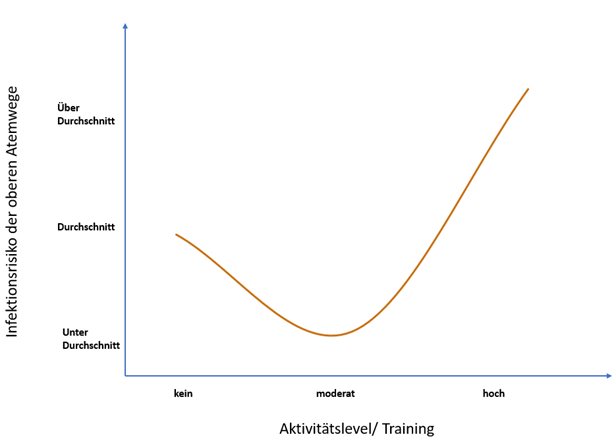
J-Kurve nach David C. Nieman. Einfluss von Bewegung auf das Infektionsrisiko
References:
- Nieman, D. (2000); Sportimmunologie: Aktuelle Perspektiven für den Sportler. Deutsche Zeitschrift für Sportmedizin; Jahrgang 51, Nr. 9
- Baum, M.; Liesen, H. (1998); Sport und Immunsystem. Deutsches Ärzteblatt 95, Heft 10.
- Pokan, R. et al. (2004), Kompendium der Sportmedizin, Springer Verlag.